Southwest Junior High Assistant Principal Brings Coaching Mindset to Leadership Role
January 14, 2026
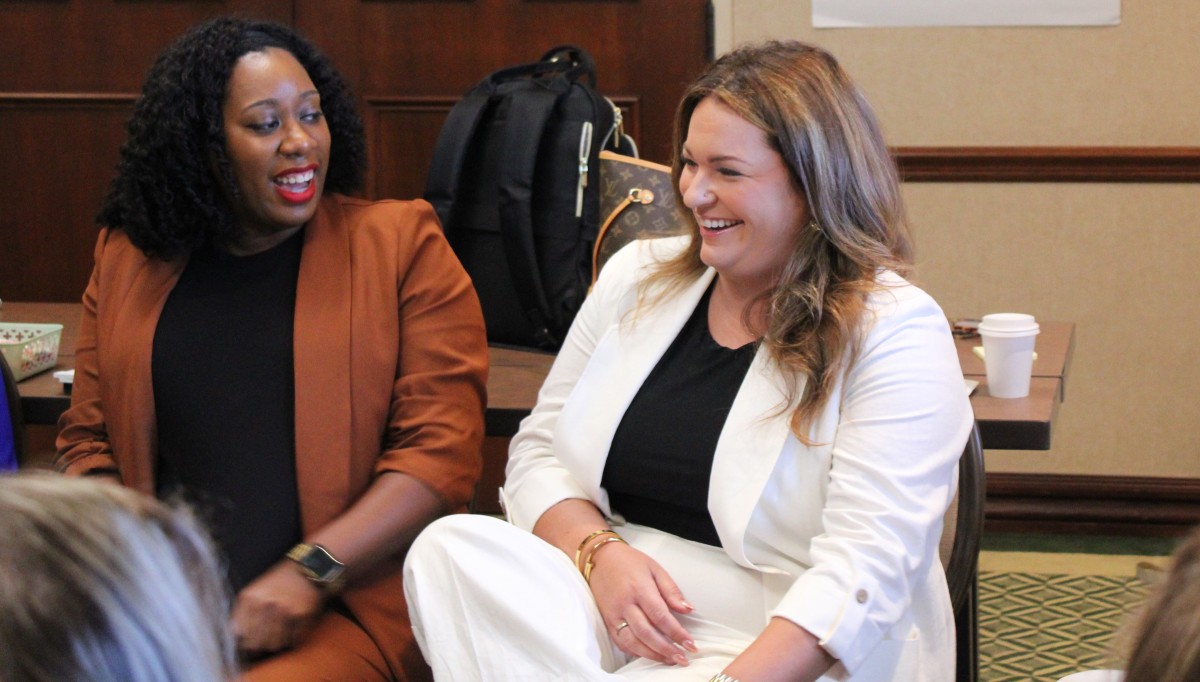
Arkansas’ Lead and Master Professional Educator Designations are programs designed to prepare experienced teachers to guide colleagues, lead collaborative learning, and strengthen classroom practice statewide. Southwest Junior High School Assistant Principal Emma Clay (right) has experienced the impact herself, supporting her growth from a classroom teacher into a trusted instructional leader in her school and district. Her story is an example of how investing in teacher leadership creates impact across an entire learning community.
By David Hehemann
After three years as an instructional facilitator at Southwest Junior High School in Springdale, Arkansas, Emma Clay is several months into her new role as assistant principal. As she works to incorporate the “coaching perspective” from her previous position into her administrative responsibilities, Clay reflects on what first drew her to education.
When she enrolled at the University of Arkansas in her hometown of Fayetteville in 2011, Clay assumed she would follow her family’s tradition of pursuing a career in medicine.
“I considered becoming an athletic trainer because I loved sports, but once I hit anatomy and physiology, I realized that wasn’t for me,” she said. “I later took an education class that included classroom observations. The moment I stepped into an elementary classroom, I knew, ‘This is for me.’”
Although she admits she did not love school as a child, from that moment on, Clay wanted to be the kind of teacher who helped children feel capable.
After earning both her undergraduate and graduate degrees in education, Clay began her career with Springdale Public Schools. For six years, she taught fifth grade at Walker Elementary before accepting her first position at the junior high level.
“When I started at Southwest, it was my first time serving as an instructional facilitator – really learning about the coaching role and how to support teachers with classroom instruction,” she said. “I focused on helping them improve teaching and learning based on specific goals they set for themselves. I just absolutely loved that work.”
Dr. Curtis Gladden, school principal, said Clay was an easy choice for assistant principal, even if the transition happened faster than expected. He said her background in elementary education and determination to serve all students made her a strong fit at the secondary level.
“As our instructional facilitator, she connected with teachers, built trust and had honest conversations about growth,” Dr. Gladden said. “Maintaining those relationships while stepping into a leadership role takes time and intentional effort. Some people are ready for that shift, some aren’t. I pushed her because I knew she had the ability – it just took a nudge.”
Dr. Gladden said moving from instructional facilitator to assistant principal means interacting differently with teachers, parents, and the community. That shift can be difficult because teachers may begin to see an administrator as “the boss.”
Clay admits the prospect of losing teachers’ trust was initially daunting.
“Fortunately, we have a great culture at Southwest – support has always been a thread here,” she said. “Our partnership with the National Institute for Excellence in Teaching (NIET) has helped with that too. Through our job-embedded professional development, the NIET model encourages coaching conversations rather than top-down evaluations.”
Because Southwest was down to one instructional facilitator instead of two, Clay had to find new ways to support teachers without adding to their workload. She decided to incorporate NIET’s “learning clusters” – weekly, job-embedded meetings in which teachers collaborate on specific instructional needs.
“Each group consists of three to six teachers, so it’s quite comfortable,” she said. “We start with a model lesson that addresses a specific need, often something a teacher in our building has tried successfully. Then teachers work together to adapt that strategy for their own classes. They leave with something ready to implement, and the next week they bring back results to discuss.”
Clay said the process is powerful because teachers are not being evaluated but rather encouraged to collaborate, experiment and learn together.
“The work is intentional and targeted to support our overall school goals,” she said. “The key has been making that time meaningful, so teachers see it as support, not another meeting. And though the meetings are only 45 minutes long, most teachers want to stick around afterward and continue the discussion.”
Strengthening Instruction Through NIET’s Lead Pathway
Clay’s leadership philosophy has been shaped in part by her participation in the NIET Lead Professional Educator Designation Pathway, a yearlong initiative designed to strengthen teachers’ instructional and leadership skills through job-embedded professional learning. She encourages other teachers to take part in the program because it is both intentional and immediately applicable.
“It doesn’t just make you a better educator – it helps you support other educators,” she said. “You can’t have one great teacher in one classroom. You must spread that excellence across the whole school. The Lead Professional Educator Pathway is the first step in learning how to do that.”
A major focus of the training was on building trust – how to connect with and coach colleagues while helping them grow.
“Once you have that trust, the next step is using data to support growth,” she said. “I’ve always collected data, but I didn’t always know how to use it effectively. The program helped me understand how to analyze it and connect it to instructional decisions. Now we constantly ask, ‘How do we know this is making an impact?’”
Clay said data helps identify strengths and gaps, but its real power lies in the conversations it sparks.
“If a group of students struggled in a particular area, we think about the barriers we might have unintentionally created,” she said. “Then we ask ourselves, ‘What will we do differently next time?’”
This work comes at an important time as Arkansas prepares to move to a full inclusion model next year, she said. This important change means all students, regardless of ability, will learn together in general education classrooms.
“This is a very exciting and long-awaited development, but it is also challenging,” she said. “Teachers are working with students with very different needs, so strengthening instructional practices is essential. The learning clusters give teachers a safe space to collaborate and find solutions together, while our use of data-driven practices helps ensure we are making positive change across the board.”
Clay credits Dr. Gladden for fostering an environment where teachers and administrators share leadership and responsibility.
“Dr. Gladden really believes in shared leadership – it doesn’t all just come from him,” she said. “He recruits people to be part of the team, to spread support, and to lead together. That’s a big reason we’re able to sustain the progress we’ve made.”