The Most Effective Lever for School Improvement Is Already in Your Building
November 13, 2025
By Kristan Van Hook, Senior Vice President for Policy and Communications
Teacher leaders, already in your building, are a powerful force for school improvement and the key to scaling high-quality instruction, improving professional learning, and retaining talent within existing budgets.
Interest in new models for staffing schools is growing, driven in large part by teacher shortages and the continuing challenge of helping all students reach college and career readiness goals. The most effective models take a new approach to the role of teacher – creating career pathways and leadership positions that elevate teachers in ways that empower them to improve teaching and learning across their building. Strategic staffing advances these new roles and, at the same time, aligns systems and structures to take full advantage of the instructional expertise and leadership potential of teacher leaders.
Team-based structures that support teachers and are led by teacher leaders address challenges with the traditional teacher role – reducing isolation, increasing opportunities to collaborate, learn, and grow, creating career pathways, and lowering teacher turnover. A number of states offer compensation for teacher leaders, creating new resources to support effective teachers in sharing their expertise and building a pipeline to grow the strongest teachers into leaders at the school and district level.
In addition to improving overall teacher effectiveness, strategic staffing addresses other challenges – getting effective teachers to the students who need them most, providing differentiated support for teachers with a range of skills and knowledge, and bringing teachers into instructional leadership of schools.
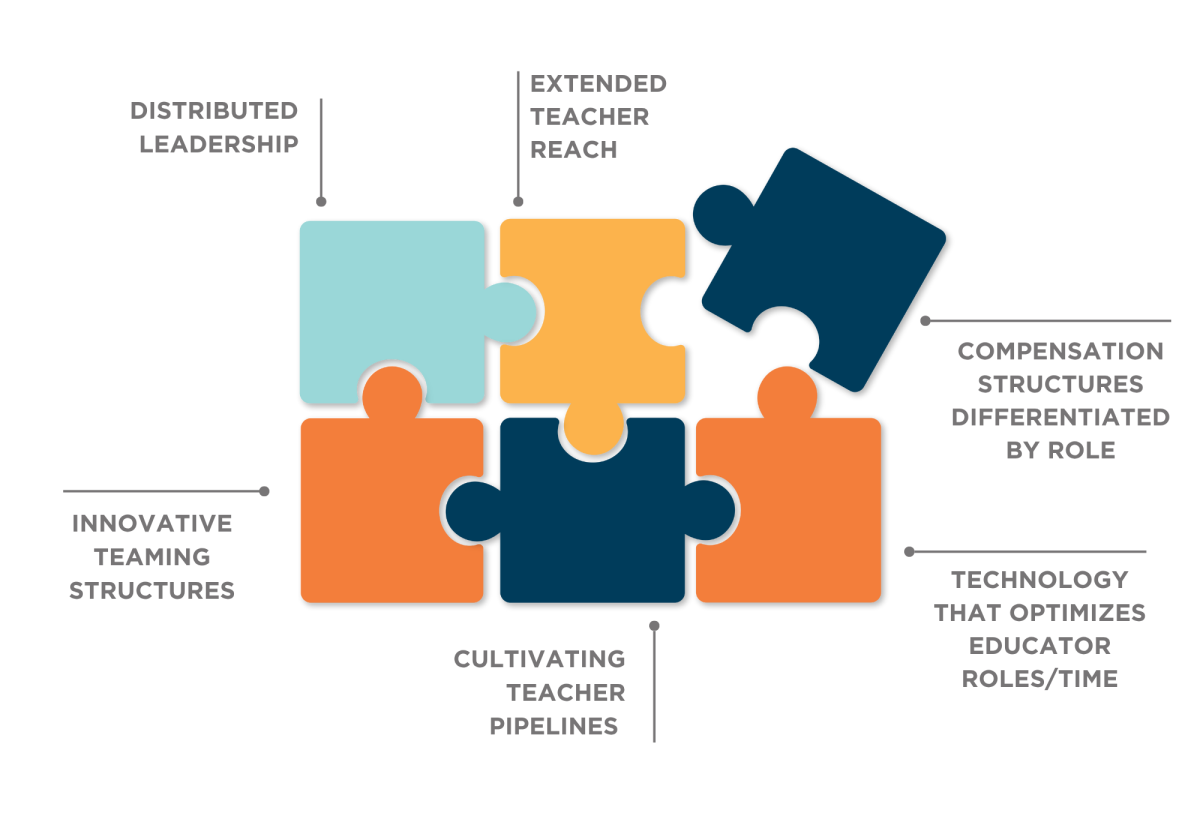
Our model for strategic staffing is called the TAP System. TAP creates new leadership roles and team-based structures for teachers, while providing support and alignment for these new structures and roles at the school and district levels. This creates a system of continuous improvement that enables schools and districts to provide consistently high-quality instruction. NIET’s model for strategic staffing drives improvements in teacher effectiveness, recruitment, retention, and, ultimately, student achievement through six key characteristics¹
Distributed Leadership.
When you are a teacher leader, it not only means you are a leader of teachers, but also that you are a teacher who is a leader. Teacher leaders want to have that broader leadership impact but absolutely do not want to give up teaching in classrooms.Laura Roussel, Chief Academic Officer at Jefferson Parish Schools, Louisiana
Given the many demands on principals’ time, they do not have the capacity to provide this level of support for each teacher by themselves. In addition, many principals report that they do not know what to look for when observing teachers or how to provide strong feedback for improvement. Elevating teachers into leadership roles to mentor teams of teachers provides the support required to ensure great teaching and learning are happening in every classroom.
Innovative Teaming Structures.
Our focus is on growing students, but to do this, we need to grow teachers. Aligning our systems to help teachers grow and improve generates excellence in the classroom. It creates a continuous cycle of improvement as more teachers want to join a team that helps them to be the best teachers they can be.Pat Mapes, Superintendent of Hamilton Southeastern Schools, Indiana
New teacher collaboration structures require redesigning school schedules to allow for weekly high-quality professional learning during school hours. Teacher leaders need time to plan, facilitate, follow up, and field test student strategies in classrooms each week. The use of common tools, such as an evidence-based instructional rubric and a protocol for collaborative teamwork, enables teachers and school leaders to create consistency in providing feedback, share a common approach to instructional leadership, and grow their own instructional practice together.
Extended Teacher Reach.
Master teachers model, co-teach, and field test student strategies in classrooms. This brings the most effective teachers into the classrooms of team members every week. Mentor teachers observe, coach, and provide feedback. Teacher leaders also bring back information about what is happening in classrooms to the school leadership team, providing a critical part of the feedback loop that improves both professional learning and coaching.
Staffing Structures That Intentionally Cultivate Teacher Pipelines.
As a teacher leader, I could see who was helping students to make the greatest gains. We identified and taught those skills to other teachers. That experience was the foundation of my approach as a principal.Omar Duron, Superintendent of Somerton School District #11, Arizona
Teacher leadership roles, such as Mentor and Master teacher, offer a pathway to identify, train, and advance future instructional leaders. The coaching and support system benefits not just new teachers and paraprofessionals, but also teacher candidates and residents as they observe experts in the classroom and are included in professional learning teams.
Compensation Structures Differentiated by Role.
A challenge for our school, especially post-pandemic, is making sure that we can attract and retain high-quality teachers. It is important for us to be a place where teachers want to stay and teach.Laura Wanstreet, Principal, Horizon Community Learning Center, Arizona
In our partner districts, Mentor and Master teachers receive stipends for taking on new roles and responsibilities and are eligible, along with all teachers, for additional compensation based on multiple measures of success in the classroom. Master teachers are released roughly 75% of their time from the classroom, while Mentor teachers are released from their classrooms for several hours a week to fulfill their responsibilities. The opportunity to earn additional compensation increases retention of effective teachers.
Technology That Optimizes Educator Roles/Time.
It’s powerful to watch another teacher use an instructional strategy and then be able to analyze what was effective or where I can improve. EE PASS lets me access videos of one-on-one instructional coaching and videos of classroom lessons to do my own learning.Jessica Carmean, Master Teacher at Jefferson Parish Schools, Louisiana
Observing an effective teacher’s lesson prompts reflection and highlights potential areas for growth. Yet, given the demands of a school schedule, teachers have few opportunities to observe other teachers’ classrooms. When leadership team members or coaches want to explain a concept like student ownership of learning, access to video clips of highly effective classroom lessons facilitates those conversations. Online platforms, such as NIET’s EE PASS, extend the impact of teacher leaders by connecting coaching conversations to resources for extended learning that optimize educators’ time.
Transforming Schools From Within.
What if we could take existing staff and resources and achieve much better results? Strategic staffing built around teacher leadership roles solves many challenges at once: expanding instructional leadership and distributing leadership in school buildings; reliably evaluating teaching and providing more frequent feedback and more useful feedback to teachers; greatly improving the relevance and effectiveness of professional learning; creating pipelines to leadership roles; increasing teacher retention; and, ultimately, accelerating student learning. Teacher leaders are the most powerful force for school improvement - and are already in your building.
¹Education First. (2023, August). Strategic school staffing landscape scan: Transforming school staffing to improve student learning and reimagine the role of teachers.